1151 Type Three-Valve Manifold
manufacturer: Kaiweixi Valve Group Co., Ltd
Eml: Merry@kaiweixi.com
Tel: +86 (577) 67038872
Mob: +86 18157711652(WeChat Same Account)
product drawing
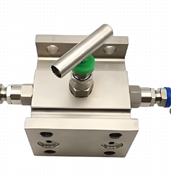
1151 Type Three-Valve Manifolds
Overview
The 1151 type three valve group is an instrument valve assembly specifically designed for use with differential pressure transmitters, consisting of two globe valves (high pressure valve, low pressure valve) and a balance valve integrated into one. Through precise internal flow channel design, it can achieve connection, disconnection, and balancing operations between differential pressure transmitters and process pipelines, ensuring the safety and accuracy of differential pressure transmitters during online maintenance, zero calibration, and commissioning processes. The valve group has a compact structure and reliable sealing, making it an indispensable instrument accessory in industrial automation control systems. Widely used in petrochemical, power, metallurgy, pharmaceuticals, food, and general industrial process control systems, it is paired with differential pressure transmitters for measuring parameters such as flow rate, liquid level, and pressure. Especially suitable for differential pressure measurement applications that require online maintenance, zero point calibration, and high reliability, it is a key auxiliary equipment to ensure the safe operation and measurement accuracy of differential pressure transmitters.
Features:
1. Integrated design
Integrating high pressure valve, low pressure valve, and balance valve into one valve body has a compact structure, occupies less space, reduces leakage points, and improves system reliability.
2. Dedicated to differential pressure transmitters
Specially designed to be compatible with differential pressure transmitters, it can be directly installed between the transmitter and the process pipeline, simplifying installation and facilitating maintenance.
3. Standardized operation sequence
Through the collaborative operation of three valves, the normal operation, zero calibration, and online isolation of the differential pressure transmitter can be achieved, preventing damage caused by one-way pressure due to misoperation.
4. Multiple valve seat forms to choose from
According to the working conditions, various valve seat forms such as conical sealing, spherical sealing, or flat sealing can be used, and the sealing performance is reliable.
5. Flexible material selection
The valve body material can be selected from stainless steel (304/316), carbon steel, etc., to meet the corrosion requirements of different media.
6. Diverse connection methods
The input end can be connected to the process pipeline using flanges, threads, or welding, and the output end can be directly connected to the transmitter. The interface is standardized and has strong universality.
Dimensions & constructral diagram
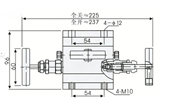
1151 Type Three-Valve Manifold constructral diagram
Parts List
| Model | Body | Joint | Stem | Cap | Packing |
|---|---|---|---|---|---|
| 1151-160 | 20# | 20# | 2Cr13 | 20# | flexible graphite |
| 1151-160P | SS304 | SS304 | SS304 | SS304 |
Performance Specification Sheet
| Test item | Pressure value |
|---|---|
| Nominal pressure | 16 |
| Casing test | 24 |
| Seal test | 17.6 |
| Pneumatic test | 9.6 |
| Applicable temperature | <180°C |
| Applicable medium | Water, steam, oil products, etc. |
Outline dimension table
| Model | A | A1 | B | B1 | 2-Φ | 2-Φ | Weight (kg) |
|---|---|---|---|---|---|---|---|
| DN6 | 54 | 54 | 41 | 41 | 4-Φ12 | 4-M10 | 2.2 |